



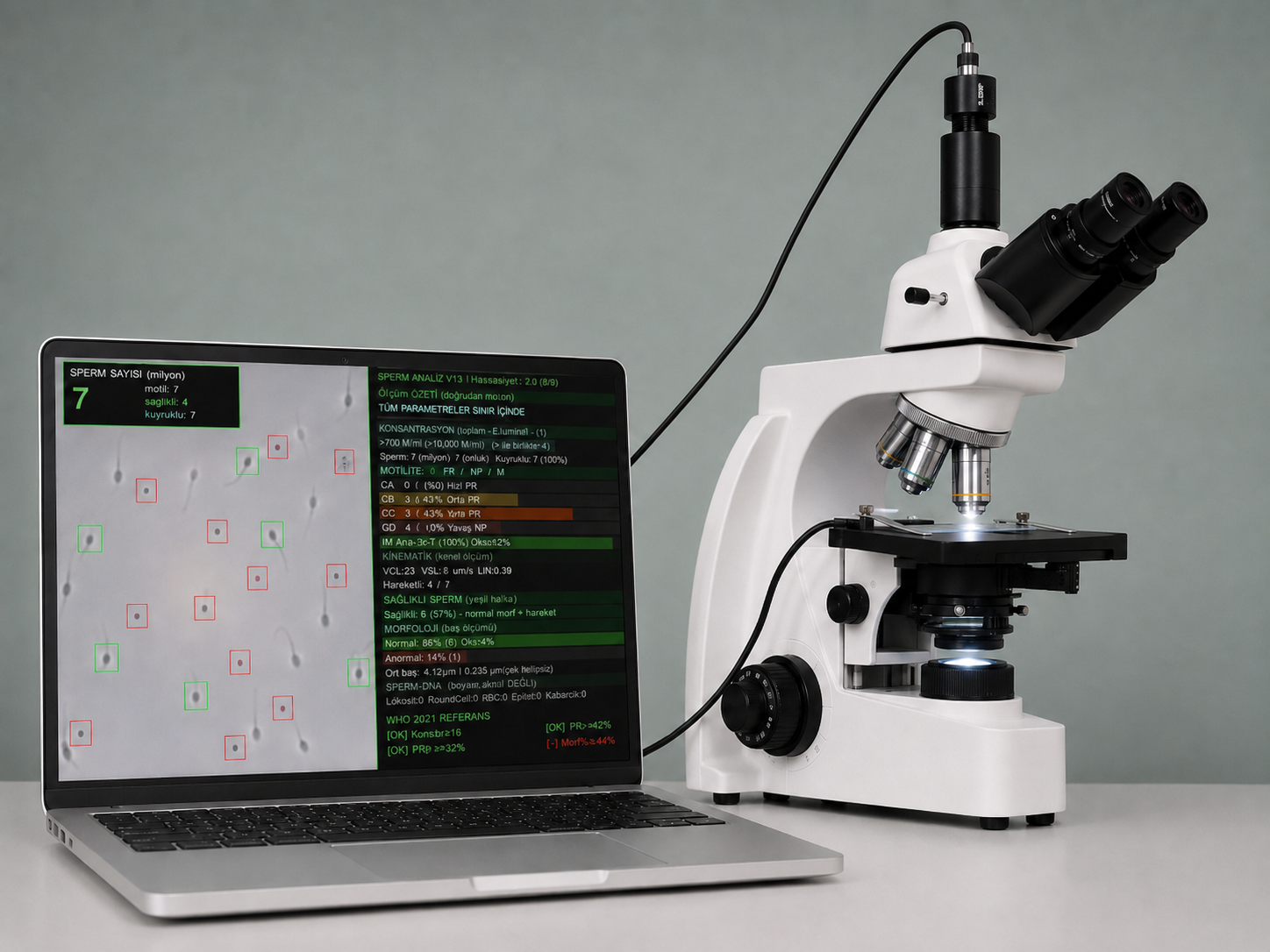
AI-Assisted Support System in Sperm Analysis
The Scientific Contribution of AI-Based Image Processing Technology to Sperm Analysis
Transforming Microscope Images into Quantitative and Traceable Data with AI
One of the basic laboratory examinations used in the evaluation of male reproductive health is semen analysis. In this examination, also known as a spermogram, the number, motility characteristics, and morphological structures of sperm cells are evaluated.
Today, AI-based image processing technologies are used to automatically identify cells in microscopic images, track their movements, and quantitatively analyse the data obtained.
The software prototype developed within our centre is a research and development project that aims to detect sperm cells in microscope images using AI-based image processing technology, track the movement of sperm cells between frames, and measure their basic movement characteristics.
The main objective of the study is not to replace laboratory evaluation, but to establish a more measurable, repeatable, and traceable standard analysis infrastructure for sperm analysis.
Why Is AI-Based Image Processing Important in Sperm Analysis?
Sperm cells are small cells that constantly move under the microscope, may approach one another, overlap, and leave the image field. Therefore, detecting a large number of sperm cells simultaneously and tracking their movements individually is a process that requires technical expertise.
AI-based image processing technology may help determine the positions of sperm-like structures in videos of cells observed under a microscope and quantitatively examine the movements of these cells over time.
In the prototype we developed, sperm cells in the image are evaluated according to visual characteristics such as:
- Size
- Shape
- Roundness
- Oval appearance
- Contrast relative to the surrounding background
The detected sperm cells are matched between consecutive image frames, and a separate movement trajectory is created for each cell.
With this approach, the aim is not only to evaluate the movement observed under the microscope visually, but also to transform it into measurable and comparable data.
Automatic Detection of Sperm Cells with AI
In the first stage of the AI-based image processing process, the microscope image is prepared for analysis. The image is converted to greyscale, image noise is reduced, and contrast enhancement procedures are applied to make the cells more distinguishable from the background.
Small structures resembling sperm heads are then identified in the image. Each candidate object is examined in terms of area, shape, size, and contrast characteristics.
Microscope grid lines, air bubbles, cellular debris, and other artefacts in the image may cause false detections. For this reason, the software applies additional image filters to eliminate structures that are not sperm cells as much as possible.
However, at the current stage of development, the structures detected by the software are not considered definitively to be sperm cells, but rather sperm cell candidates that meet the algorithm’s criteria.
Tracking Sperm Movement with AI
After sperm detection, the software attempts to track each cell candidate throughout the video.
The position of a sperm candidate identified in one frame is compared with the positions of objects in the next frame. The object that is most suitable in terms of distance and direction of movement is considered to be the continuation of the same cell.
Through this process, a movement trace is created over time for each sperm candidate.
The AI-based image processing tracking system may assist in examining the following data:
The cell’s total movement distance,
Direction of movement,
Continuity of movement,
Degree of linear progression,
Changes in direction occurring during movement,
Distance travelled within a specific period.
The ability to record the movements of a large number of cells individually may contribute to a detailed investigation of sperm motility.
Repeatability
The software’s use of fixed criteria allows the same image to be analysed in a similar way at different times. This makes it possible to compare results and measure the development of the system.
Tracking a Large Number of Cells
The human eye may have difficulty tracking a large number of moving sperm cells individually. AI-based systems, however, can track multiple cells simultaneously and create a movement trajectory for each one.
Kinematic Analysis
AI-based image processing helps quantitatively examine the speed and movement paths of sperm cells. Measurements such as VCL and VSL allow movement characteristics to be evaluated in greater detail.
Contribution to the Laboratory Process
Once scientific and clinical validations have been completed, these systems may be used in areas such as:
Pre-evaluating images,
Marking sperm cells,
Creating movement trajectories,
Preparing quantitative measurements,
Supporting expert examination.
The aim is not to replace the laboratory specialist, but to provide the specialist with organised and measurable data.
Scientific Validation
For the system to be used in sperm analysis, its results must be compared with expert evaluations and accepted laboratory methods.
The following topics are examined during the validation process:
The rate of correctly detecting sperm cells,
The rate of incorrectly detecting non-sperm structures,
The difference between automatic and expert counts,
Continuity of cell tracking,
Accuracy of movement classifications,
Reliability of kinematic measurements,
Performance across different samples, microscopes, cameras, and image qualities.
Not only the conditions in which the system is successful, but also the conditions in which it makes errors must be evaluated transparently.
Does AI Replace Expert Evaluation?
A single result produced by AI is not sufficient to determine whether a person is fertile or infertile.
Semen analysis must be evaluated by a specialist physician together with medical history, physical examination, hormonal and genetic tests, and other findings.
Because sperm values may vary on different days, the test should be repeated when necessary. The role of AI systems is not to replace expert decisions, but to provide quantitative and visual data that support the evaluation.
The AI-based image processing sperm analysis prototype developed at our centre is a research and development project conducted for the automatic detection of sperm cell candidates in microscope images, the tracking of their movements, and the measurement of their basic kinematic characteristics.
The most important contributions that AI-based image processing technology may provide to sperm analysis include the ability to track a large number of cells simultaneously, record movement trajectories, calculate kinematic measurements, and support expert evaluation with quantitative data.
However, the system has not been clinically validated in its current form. The accuracy, reliability, and potential areas of use of the software can be determined only after expert-comparative and controlled scientific studies have been completed.
Important information: The AI-based image processing software presented is a research prototype in the development stage. It is not a medical device or diagnostic tool. It does not diagnose fertility or infertility, does not recommend treatment, and cannot be used to make health-related decisions. It does not replace expert laboratory evaluation. Semen analysis must be performed under appropriate laboratory conditions by trained specialists, and the results must be interpreted by the relevant specialist physician.