



Embryo Freezing and Frozen Embryo Transfer
Embryo Freezing and Frozen Embryo Transfer: Process, Benefits, and Frequently Asked Questions
In IVF treatment, not every embryo needs to be transferred during the same treatment cycle. Embryos of suitable quality can be preserved for future use through embryo freezing, allowing couples to undergo a frozen embryo transfer at a later date without necessarily repeating ovarian stimulation and egg retrieval.
Today, embryo freezing is an important part of assisted reproductive treatments. Thanks to modern vitrification techniques, suitable embryos can be stored at very low temperatures and prepared for transfer when needed.
At Dr.HIT Cyprus IVF Center, embryo freezing and embryo transfer are among the procedures carried out within the embryology laboratory. Treatment is planned individually by considering factors such as the patient’s age, ovarian reserve, embryo development, uterine condition, and previous treatment history.
What Is Embryo Freezing?
Embryo freezing is the process of preserving embryos obtained through IVF or intracytoplasmic sperm injection (ICSI) and considered suitable for transfer at very low temperatures for possible future use.
During IVF treatment, eggs are collected and fertilized with sperm cells in the laboratory. After fertilization, the embryos are monitored for a specific period of time. Embryos that are not transferred and are considered suitable for freezing may be preserved for future treatment.
Embryos can be frozen at different stages of development, although freezing at the blastocyst stage is commonly used today. The decision regarding which embryos should be frozen and at what stage depends on embryo development and the laboratory protocol of the treatment center.
Embryo freezing provides greater flexibility in IVF treatment by allowing suitable embryos obtained during one treatment cycle to be used in the future.
Why Are Embryos Frozen?
Embryo freezing may be recommended or preferred for several reasons.
It may be considered when suitable embryos remain after an IVF transfer, when a future pregnancy is planned, when the first embryo transfer does not result in pregnancy, when the ovaries respond excessively to stimulation and there is a risk of ovarian hyperstimulation syndrome (OHSS), when the endometrium is not considered suitable for transfer during the current cycle, or when embryo transfer needs to be postponed because of genetic testing or other clinical reasons.
Embryo freezing is not necessary for every patient. The decision to freeze and transfer embryos should be made according to the patient’s clinical condition and embryo development.
How Are Embryos Frozen?
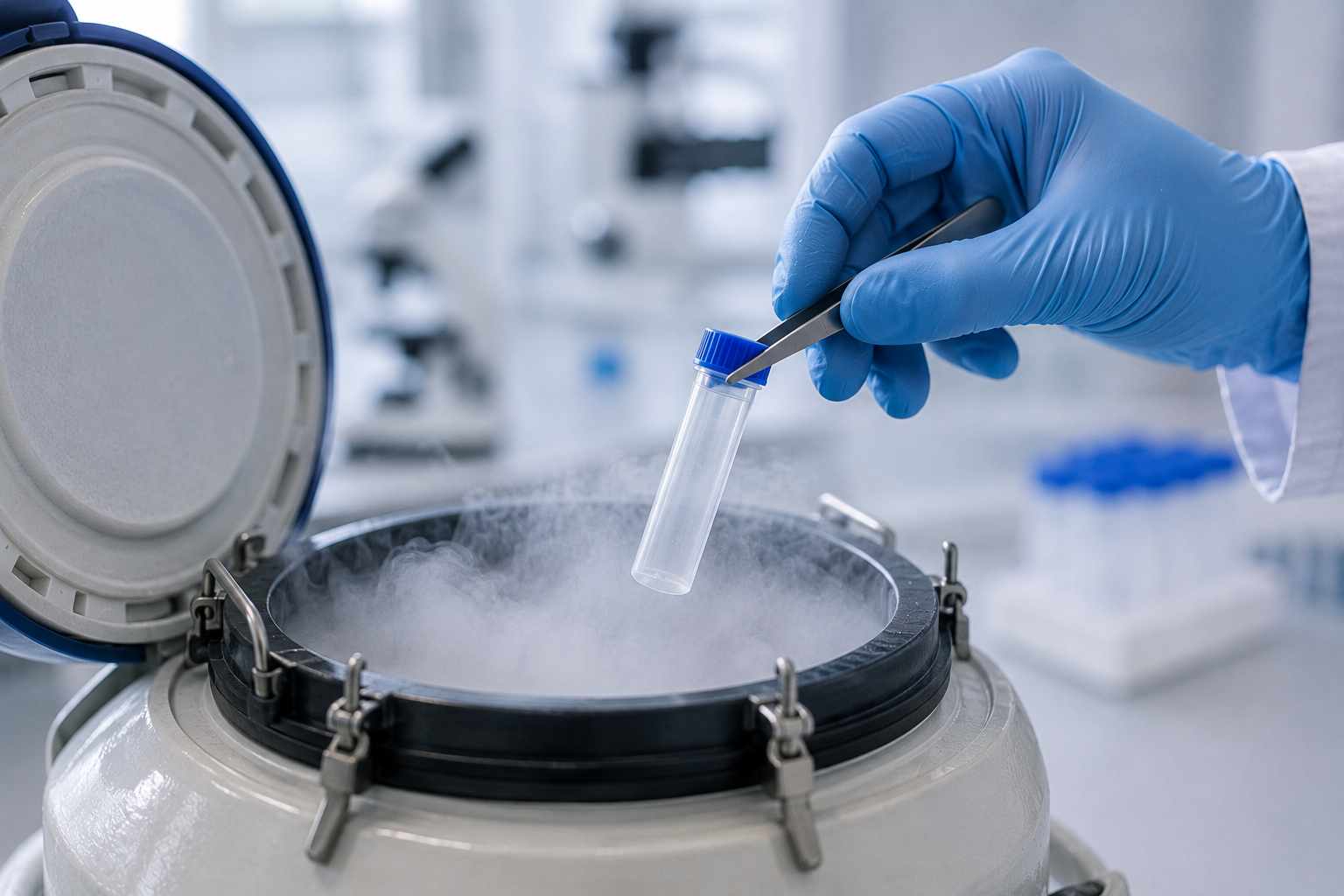
Modern IVF laboratories commonly use a rapid cryopreservation method known as vitrification for embryo freezing.
During vitrification, embryos are first prepared with special cryoprotective solutions designed to help protect the cells during the freezing process. The embryos are then cooled extremely rapidly into a glass-like state without the formation of large ice crystals.
The aim is to minimize the risk of cellular damage that may occur due to ice crystal formation.
Embryos are then stored in special cryogenic storage systems in liquid nitrogen at approximately -196°C.
Vitrification is now considered one of the established methods used for the cryopreservation of human embryos and oocytes.
How Long Can Frozen Embryos Be Stored?
Embryos can be preserved for long periods when appropriate cryopreservation and storage conditions are maintained.
Current evidence does not indicate that the passage of time alone necessarily makes a properly stored embryo unsuitable for future use. However, the permitted storage period may depend on the policies of the treatment center and the legal regulations of the country in which treatment is provided.
Couples considering long-term embryo storage should therefore obtain information not only about medical considerations but also about storage periods, consent procedures, and applicable regulations.
What Is Frozen Embryo Transfer?
Frozen embryo transfer, also known as FET, is the process of warming a previously frozen embryo in the laboratory and transferring it into the uterus at an appropriate time.
A new egg retrieval procedure is not required for a frozen embryo transfer because embryos obtained and preserved during a previous IVF cycle are used.
This can be particularly beneficial for couples who have more than one suitable embryo. If another pregnancy is planned in the future, or if the first embryo transfer does not result in pregnancy, another transfer may be performed without starting a completely new ovarian stimulation and egg retrieval cycle.
How Is the Uterus Prepared for Frozen Embryo Transfer?
One of the most important stages of frozen embryo transfer is preparing the lining of the uterus, known as the endometrium, for embryo implantation.
In some patients, transfer can be planned according to the natural menstrual cycle. In women who ovulate regularly, ovulation may be monitored using ultrasound examinations and, when necessary, hormone measurements.
In other patients, estrogen and progesterone medications may be used to prepare the endometrium and control the timing of embryo transfer.
The most appropriate approach depends on factors such as menstrual regularity, hormone levels, endometrial development, and previous treatment history.
There is therefore no single frozen embryo transfer protocol that is suitable for every patient. At Dr.HIT Cyprus IVF Center, treatment planning is personalized according to each patient’s clinical characteristics.
How Is a Frozen Embryo Transferred?
On the day of transfer, the embryo is carefully warmed in the embryology laboratory and reassessed.
An embryo that survives the warming process and is considered suitable for transfer is placed inside the uterus using a thin embryo transfer catheter.
Embryo transfer is generally a short procedure and, in most cases, does not require anesthesia.
After the transfer, medications and the timing of the pregnancy test are determined by the medical team according to the patient’s treatment plan.
Is Frozen Embryo Transfer More Successful Than Fresh Embryo Transfer?
One of the most important points to understand is that no single type of embryo transfer can be considered more successful for every patient.
Today, success rates with frozen embryo transfer can be comparable to those achieved with fresh embryo transfer. In certain patient groups, preparing the uterus during a cycle that is not affected by ovarian stimulation may offer advantages.
Frozen embryo transfer may be particularly appropriate when there is an excessive ovarian response, when the endometrium is not suitable for transfer, or when embryo transfer needs to be postponed for another medical reason.
However, routinely freezing all embryos has not been proven to improve live birth rates in every patient. Therefore, a “freeze-all” strategy should not automatically be considered the best approach for everyone.
The choice between fresh and frozen embryo transfer should be individualized according to the patient’s clinical situation.
What Are the Advantages of Embryo Freezing?
Embryo freezing can make IVF treatment more flexible.
When several suitable embryos are obtained from a single egg retrieval cycle, embryos that are not transferred immediately can be preserved for future use.
This means that if another embryo transfer is required, the patient may not need to repeat ovarian stimulation and egg retrieval.
Embryo freezing can also be helpful for couples planning another child in the future. Suitable embryos remaining from the first treatment cycle may be used years later for another pregnancy attempt.
In some cases, postponing embryo transfer until a more appropriate menstrual cycle may also provide medical and practical advantages.
Does Every Frozen Embryo Survive the Warming Process?
No. Although embryo survival rates are high with modern vitrification techniques, it cannot be guaranteed that every embryo will survive freezing and warming.
Factors such as the developmental stage of the embryo, its quality before freezing, the laboratory technique used, and the experience of the embryology laboratory may affect the outcome.
For this reason, patients should receive information not only about embryo transfer success rates but also about possible outcomes following the warming of frozen embryos.
Does Embryo Freezing Affect the Health of the Baby?
Embryo freezing has been used in assisted reproduction for many years. Current scientific evidence generally supports the safety of using frozen embryos in fertility treatment.
However, from a medical perspective, it would not be appropriate to claim that there are absolutely no risks.
Pregnancy and birth outcomes following IVF can be influenced by many factors, including maternal age, general health, multiple pregnancy, the embryo transfer protocol, and other individual characteristics.
Children born after fresh and frozen embryo transfers have been monitored in scientific studies for many years. Overall safety data are reassuring, although small differences in certain pregnancy or birth outcomes have been reported.
For this reason, each patient should be evaluated individually.
Does Embryo Freezing Change the Genetic Structure of the Embryo?
The purpose of vitrification is not to genetically alter the embryo. It is designed to preserve an existing embryo in a state of suspended biological activity for possible future use.
However, freezing an embryo does not mean that the embryo has been proven to be genetically normal.
If the chromosomal structure of an embryo needs to be evaluated, separate genetic testing methods such as preimplantation genetic testing (PGT) may be required.
Embryo quality assessment and genetic testing are therefore not the same process.
How Does Embryo Freezing Affect IVF Success?
The likelihood of a successful IVF outcome does not depend only on whether an embryo is fresh or frozen.
Many factors may influence treatment success, including maternal age, egg and embryo quality, the developmental stage of the embryo, endometrial condition, laboratory conditions, sperm-related factors, and previous pregnancy or IVF history.
For this reason, a single success percentage found online should not be assumed to apply to every patient.
At Dr.HIT Cyprus IVF Center, clinical findings and embryological information are evaluated together to create an individualized treatment plan for each patient.
Does Embryo Freezing Offer Financial Advantages?
When several suitable embryos are obtained during a single IVF cycle, freezing embryos can make future fertility treatment easier to plan.
Because previously created embryos are used during frozen embryo transfer, another egg retrieval procedure may not be necessary.
For some couples, this may reduce both the physical burden of treatment and the cost associated with starting a completely new IVF cycle.
However, embryo freezing, storage, and transfer fees may vary depending on the treatment center and storage period. Financial considerations should therefore be evaluated individually.
Embryo Freezing at Dr.HIT Cyprus IVF Center
The embryology laboratory is one of the most important components of IVF treatment.
Embryo culture, assessment, freezing, storage, warming, and preparation for embryo transfer are carried out under controlled laboratory conditions.
At Dr.HIT Cyprus IVF Center, procedures such as embryo culture, embryo transfer, and embryo freezing are performed within the embryology laboratory.
Treatment planning takes into account not only laboratory findings but also the patient’s age, ovarian reserve, uterine condition, previous treatments, and other clinical characteristics.
Rather than applying the same protocol to every patient, the aim is to develop a treatment plan according to individual needs.
Frequently Asked Questions
Can frozen embryos be used later?
Yes. Embryos that have been stored appropriately can later be warmed and assessed for transfer. However, it cannot be guaranteed that every embryo will remain suitable for transfer after warming.
Is another egg retrieval required for frozen embryo transfer?
No. If previously frozen embryos are available, another egg retrieval procedure is not required solely for the frozen embryo transfer.
Is anesthesia required during embryo transfer?
Embryo transfer is generally a short procedure that can be performed without anesthesia in most patients. Different approaches may occasionally be required depending on the individual situation.
How is the uterus prepared for frozen embryo transfer?
The uterus may be prepared by monitoring the patient’s natural menstrual cycle or by using hormonal medications prescribed by the physician. The appropriate method varies from patient to patient.
Does embryo freezing guarantee pregnancy?
No. Embryo freezing provides the possibility of using embryos in the future, but it does not guarantee pregnancy or live birth.
The chances of success depend on factors including maternal age, embryo characteristics, uterine condition, and other clinical factors.
Is a frozen embryo better than a fresh embryo?
This cannot be generalized to every patient.
Frozen embryo transfer may be advantageous in certain situations, while fresh embryo transfer may be more appropriate in others. The decision should be based on individual clinical assessment.
Conclusion: Preserving Embryos for the Future
Embryo freezing is an important part of modern IVF treatment.
By allowing suitable embryos obtained during one treatment cycle to be preserved for future use, it can provide couples with additional opportunities for another pregnancy attempt or for planning another child later in life.
Modern vitrification techniques allow embryos to be stored for extended periods, while frozen embryo transfer may reduce the need to undergo ovarian stimulation and egg retrieval again for every new transfer attempt.
However, decisions about embryo freezing and frozen embryo transfer should be individualized.
The choice between fresh and frozen embryo transfer, the method used to prepare the uterus, and the timing of embryo transfer should all be planned according to the patient’s medical and reproductive characteristics.
At Dr.HIT Cyprus IVF Center, embryo freezing and embryo transfer are evaluated within the framework of modern embryology laboratory practices and individualized treatment planning.
If you would like to learn more about embryo freezing, frozen embryo transfer, or the IVF treatment approach that may be suitable for you, you can contact the Dr.HIT team and request an individual evaluation.
This content is intended for general informational purposes only and should not be considered a substitute for individual medical advice or examination.